September 2026 Market Update
September 2026 Market Update
Rough Week for the Bond Market
Bond markets remained under pressure this week, with the 10-year Treasury yield closing above 5.2% on Thursday. Interest rates surged on Wednesday following a stronger-than-expected September Purchasing Managers’ Index (PMI) reading, rising oil prices, a weak 5-year Treasury auction, and hawkish remarks from Federal Reserve officials. In response to these developments, market expectations shifted toward a more aggressive path of monetary tightening, as reflected in pricing from the CME FedWatch Tool.
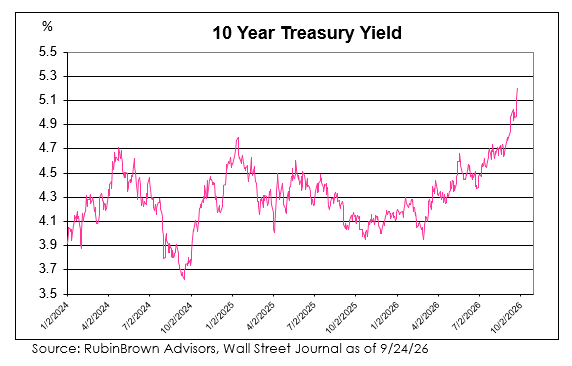
In recent commentaries, we have written about some of the reasons why yields have been increasing including persistent inflation concerns, rising fiscal deficits, heavy Treasury supply, and growing borrowing needs across both the public and private sectors.
Rising Treasury yields can increase borrowing costs across the economy by pushing up rates on mortgages, corporate loans, and other forms of credit, which may slow economic growth. Higher yields can also make bonds more appealing compared with richly valued equities, potentially reducing investor demand for stocks and weighing on equity returns.
Not All Bad: How Rising Yields Are Improving the Outlook for Bond Investors
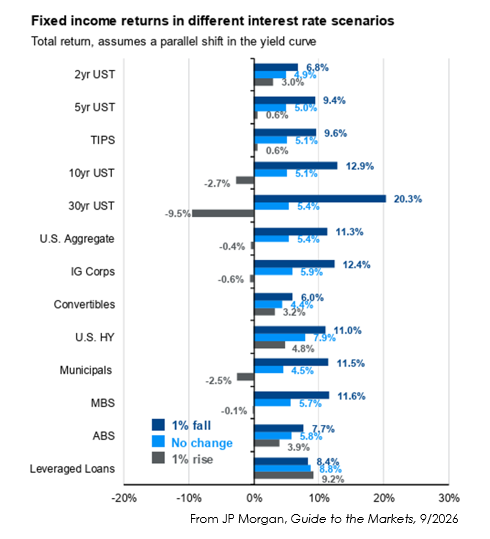
Fixed income markets have delivered modest returns year to date, as losses from rising yields have largely offset coupon income. Looking ahead, however, the investment outlook for fixed income has improved significantly.
Bonds play a vital role in diversified portfolios, providing both a steady stream of income and an important source of diversification. While rising interest rates can initially weigh on bond prices, their longer-term impact is often more favorable. As bonds mature and proceeds are reinvested at higher yields, portfolios gradually benefit from increased income generation.
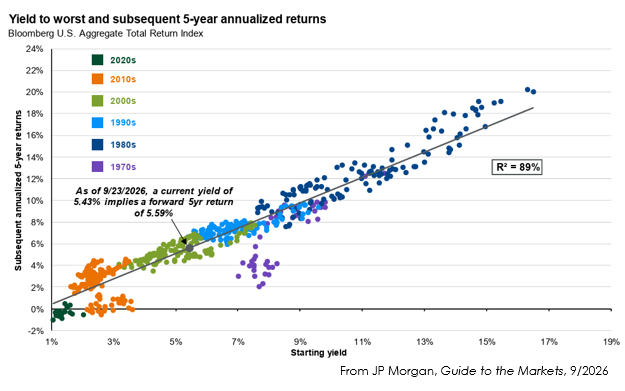
Yields across U.S. and global aggregate bond markets are near their highest levels in more than two decades. For investors entering the fixed income market today, these elevated yields translate into attractive income opportunities and provide a meaningful buffer against potential future increases in interest rates.
Fixed income also offers important diversification benefits. If economic conditions were to deteriorate and growth were to slow, an environment that typically pressures equities and prompts central banks to lower interest rates, bond yields would likely decline. In the event of a more pronounced slowdown, those declines could be substantial, generating capital gains for bondholders and helping offset weakness in risk assets.
As a result, despite disappointing fixed income returns so far in 2026, the investment case for bonds has strengthened considerably. Higher starting yields have improved prospective return potential, while the asset class continues to provide valuable portfolio diversification and downside protection in a weakening economic environment.
Disclosures & Definitions
RubinBrown Advisors, LLC is an SEC-registered investment advisor under the Investment Advisers Act of 1940. RubinBrown Advisors, LLC is wholly-owned by RubinBrown LLP.
Views expressed are as of the date(s) referenced, based on the information available at that time, and may change based on market and other conditions. These are the views of the authors’ of this piece and may differ from advisors within RubinBrown Advisors, LLC. Information provided in this email is for informational and educational purposes only, it should not be construed as a specific recommendation of any security, sector or investment strategy. Please contact your investment advisor to discuss your personal portfolio. Investment decisions should be based on an individual or family’s own goals, time horizon and tolerance for risk.
Past performance is no guarantee of future results. Different types of investments involve varying degrees of risk. Therefore, there can be no assurance that the future performance of any specific investment or investment strategy, including the investments and/or investment strategies recommended and/or undertaken by RubinBrown Advisors, will be profitable, equal any corresponding indicated historical performance level(s), be suitable for your portfolio or individual situation, or prove successful. No amount of prior experience or success should be construed that a certain level of results or satisfaction will be achieved if RubinBrown Advisors is engaged, or continues to be engaged, to provide investment advisory services. Moreover, you should not assume that any discussion or information contained in this presentation serves as the receipt of, or as a substitute for, personalized investment advice from RubinBrown Advisors. A copy of our current written disclosure Brochure discussing our advisory services and fees is available upon request or at www.rubinbrownadvisors.com. The scope of the services to be provided depends upon the needs and requests of the client and the terms of the engagement. Please Remember:
These materials contain “forward-looking” information that is not purely historical in nature. Such information may include, among other things, projections, forecasts or estimates of cash flows, yields or returns, scenario analyses and proposed or expected portfolio composition. The forward-looking information contained herein is based upon certain assumptions about future events or conditions and intended only to illustrate hypothetical results under those assumptions (not all of which will be specified herein). Actual events or conditions are unlikely to be consistent with, and may differ materially from, those assumed. In addition, not all relevant events or conditions may have been considered in developing such assumptions. Accordingly, actual results will vary, and the variations may be material. The information included in this report is based upon information reasonably available to RubinBrown as of the date noted herein. RubinBrown believes these sources to be reliable; however, these sources cannot be guaranteed as to their accuracy or completeness. The assets discussed in this report may not represent all your assets. In addition to reviewing this report prepared by RubinBrown please review and rely upon as authoritative account statements received directly from your Custodians, Managers, and/or Administrators.
Historical performance results for investment indices, benchmarks, and/or categories have been provided for general informational/comparison purposes only, and generally do not reflect the deduction of transaction and/or custodial charges, the deduction of an investment management fee, nor the impact of taxes, the incurrence of which would have the effect of decreasing historical performance results. It should not be assumed that your RubinBrown Advisors account holdings correspond directly to any comparative indices or categories. Please Also Note: (1) Performance results do not reflect the impact of taxes; (2) comparative benchmarks/indices may be more or less volatile than your RubinBrown accounts; and (3) a description of each comparative benchmark/index is available upon request.