August 2026 Market Update
August 2026 Market Update
Holy Yields! A Wild Week for the Bond Market
Treasury yields moved sharply higher early in the week, with the 30-year Treasury yield briefly surpassing 5.3%, its highest level in nearly two decades, while the 10-year yield remained near 4.7%. Investors continued to demand greater compensation for owning long-duration bonds amid persistent inflation concerns, rising fiscal deficits, heavy Treasury supply, and growing borrowing needs across both the public and private sectors.
This week's move was a reminder that bond markets are increasingly being driven by supply-and-demand dynamics as much as monetary policy. Between expanding federal borrowing requirements and substantial capital raising by hyperscalers to fund AI infrastructure, investors are demanding higher yields to absorb the growing supply of long-duration debt. The result has been renewed pressure on bond prices, steeper long-end yields, and elevated volatility across fixed income markets.
On Wednesday the bond market caught a bid after several days of intense selling pressure as the U.S. Treasury Department's announcement that it will at least double its long-duration bond buyback program, increasing purchases from $2 billion to at least $4 billion. The move is intended to improve liquidity and support the long end of the Treasury market.
Looking forward, the long end of the bond market is driven by Fed policy, inflation expectations, real growth expectations, “term premium” (extra return investors demand to hold long-term bonds instead of less-volatile Treasury bills), and supply/demand dynamics.
Higher for Longer: Fed Maintains Hawkish Hold
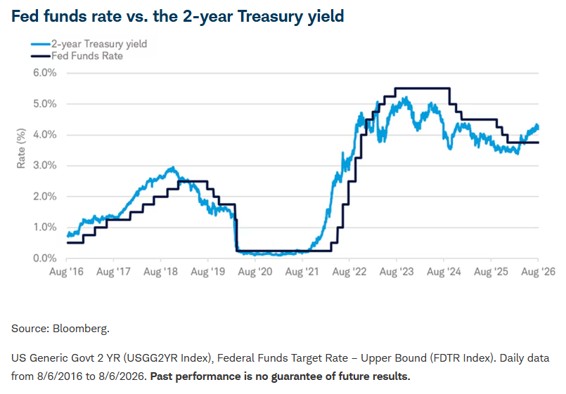
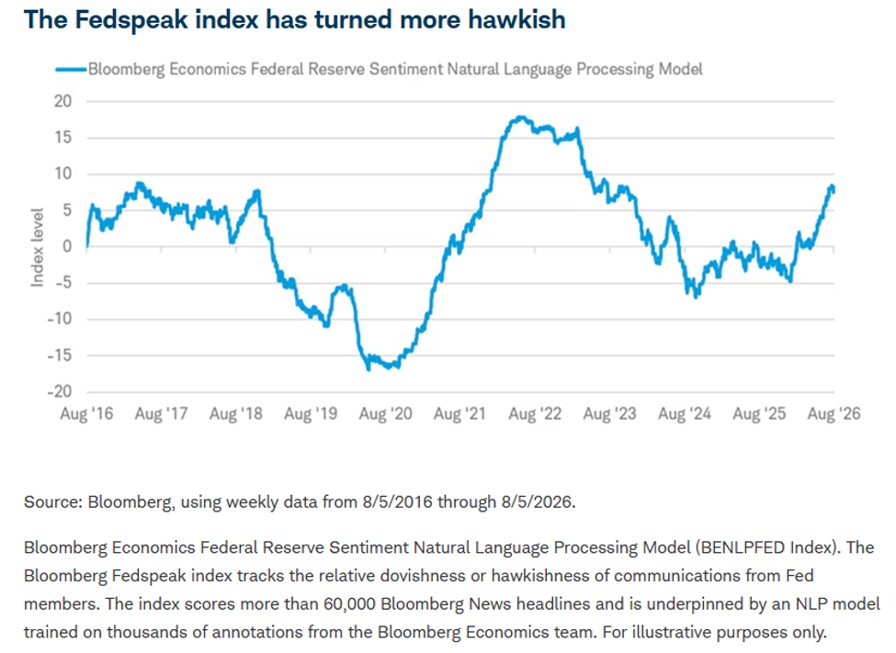
The Fed has recently shifted toward a more hawkish stance amid continued economic resilience and ongoing inflation uncertainty stemming from higher oil prices and a stable labor market.
Although the federal funds rate remains unchanged at 3.50% to 3.75%, three voting members favored a rate increase at the July meeting. Meanwhile, the 2-year Treasury yield has moved above the upper bound of the target range, indicating expectations for tighter monetary policy and higher short-term rates in the future.
Inflation Expectations Remain Steady
Despite inflation running above the Fed's 2% target, market participants generally appear to view the recent inflation surge as not translating into significantly higher long-run inflation expectations. The moderation in core inflation and the absence of major upside surprises have helped keep inflation expectations relatively anchored.
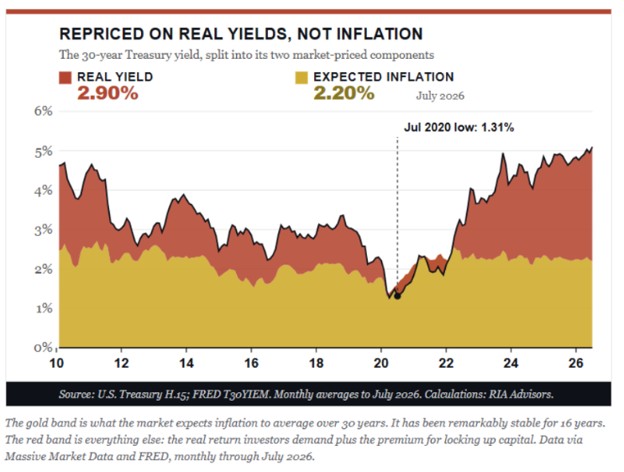
With inflation expectations broadly stable and investors requiring higher yields amid fiscal, growth, and policy uncertainty, real yields have increased. This suggests markets are tightening financial conditions not because they fear runaway inflation, but because they are demanding greater real compensation for holding longer-duration assets.
The AI Buildout Is Increasing Competition for Capital
Investors are becoming more concerned about the rapid increase in borrowing by hyperscalers and are also questioning whether the Federal Reserve will stay focused on fighting inflation if oil prices rise again.
At the same time, the AI boom has led to a sharp increase in corporate borrowing, with technology companies and the U.S. government competing for the same investment dollars.
Higher interest rates may reflect expectations for stronger economic growth. Tech companies are raising large amounts of money to fund AI investments. According to Nomura Securities, companies have borrowed about $200 billion so far this year, equal to roughly 25% of the U.S. Treasury's net debt issuance during the same period. As companies are willing to pay more for capital, investors are also demanding higher yields on government bonds.
In the U.S., much of the AI investment boom is being funded through the debt markets. Heavy borrowing by hyperscalers is putting upward pressure on bond yields and increasing competition for fixed-income investor capital.
Foreign Demand for U.S. Debt Remains Resilient
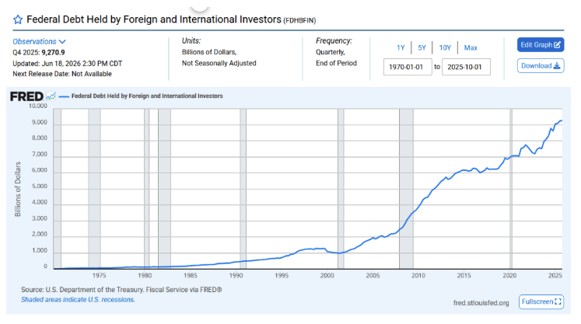
One of the more interesting observations is that foreign ownership of U.S. debt remains substantial even amid concerns about deglobalization, tariffs, and geopolitical rivalry. The reason is that there is still no market that matches U.S. Treasuries in terms of size, liquidity, and reserve-currency status. Foreign investors may diversify somewhat, but the Treasury market remains the primary destination for a large share of global savings.
The Return to Normal: Why Higher Interest Rates May Be Good for Growth
“While it sounds frightening to say rates are higher than they’ve been in nearly 20 years, the past two decades are the era that was abnormal. The U.S. economy has survived—thrived, actually—during periods of higher interest rates. The return of normality augurs well for the productive allocation of capital, which is good for growth and job creation.
This isn’t to ignore the two more worrying reasons for higher yields. Concerns about future inflation may explain some of the rise, and the fiscal mess of most Western governments should push up yields.” – Wall Street Journal
Disclosures & Definitions
RubinBrown Advisors, LLC is an SEC-registered investment advisor under the Investment Advisers Act of 1940. RubinBrown Advisors, LLC is wholly-owned by RubinBrown LLP.
Views expressed are as of the date(s) referenced, based on the information available at that time, and may change based on market and other conditions. These are the views of the authors’ of this piece and may differ from advisors within RubinBrown Advisors, LLC. Information provided in this email is for informational and educational purposes only, it should not be construed as a specific recommendation of any security, sector or investment strategy. Please contact your investment advisor to discuss your personal portfolio. Investment decisions should be based on an individual or family’s own goals, time horizon and tolerance for risk.
Past performance is no guarantee of future results. Different types of investments involve varying degrees of risk. Therefore, there can be no assurance that the future performance of any specific investment or investment strategy, including the investments and/or investment strategies recommended and/or undertaken by RubinBrown Advisors, will be profitable, equal any corresponding indicated historical performance level(s), be suitable for your portfolio or individual situation, or prove successful. No amount of prior experience or success should be construed that a certain level of results or satisfaction will be achieved if RubinBrown Advisors is engaged, or continues to be engaged, to provide investment advisory services. Moreover, you should not assume that any discussion or information contained in this presentation serves as the receipt of, or as a substitute for, personalized investment advice from RubinBrown Advisors. A copy of our current written disclosure Brochure discussing our advisory services and fees is available upon request or at www.rubinbrownadvisors.com. The scope of the services to be provided depends upon the needs and requests of the client and the terms of the engagement. Please Remember:
These materials contain “forward-looking” information that is not purely historical in nature. Such information may include, among other things, projections, forecasts or estimates of cash flows, yields or returns, scenario analyses and proposed or expected portfolio composition. The forward-looking information contained herein is based upon certain assumptions about future events or conditions and intended only to illustrate hypothetical results under those assumptions (not all of which will be specified herein). Actual events or conditions are unlikely to be consistent with, and may differ materially from, those assumed. In addition, not all relevant events or conditions may have been considered in developing such assumptions. Accordingly, actual results will vary, and the variations may be material. The information included in this report is based upon information reasonably available to RubinBrown as of the date noted herein. RubinBrown believes these sources to be reliable; however, these sources cannot be guaranteed as to their accuracy or completeness. The assets discussed in this report may not represent all your assets. In addition to reviewing this report prepared by RubinBrown please review and rely upon as authoritative account statements received directly from your Custodians, Managers, and/or Administrators.
Historical performance results for investment indices, benchmarks, and/or categories have been provided for general informational/comparison purposes only, and generally do not reflect the deduction of transaction and/or custodial charges, the deduction of an investment management fee, nor the impact of taxes, the incurrence of which would have the effect of decreasing historical performance results. It should not be assumed that your RubinBrown Advisors account holdings correspond directly to any comparative indices or categories. Please Also Note: (1) Performance results do not reflect the impact of taxes; (2) comparative benchmarks/indices may be more or less volatile than your RubinBrown accounts; and (3) a description of each comparative benchmark/index is available upon request.